Wednesday, 21 April 2021

The Sonic Hamster Wheel

Russolo describes his Scoppiatori Exploder/ Burster as producing 'noises like the bursting of objects that break and shatter', I've had a bit of difficulty trying to recreate this effect. At first I was thinking along the lines of a lever using strings to lift up on a number of metal plates similar to a Venetian blind, to then drop and crash down on to a suitable resonating material. But my experiments produced a very unsatisfactory sound. So I'm now planning to using a rotating drum which will lift up a variety of material such as metal, ball bearings in the manner of a cement mixer to let it crash down. Of course the use of cement mixers and revolving drums in sound art is well established. I attended the re-enactment of the Concerto for voice and machinery at the ICA in 2007. Here the performers used two cement mixers into which were smashed bottles. You can see excerpts from this here...... 

https://youtu.be/9RcGxi2Z7J0 

Please google 'Concerto for voice and machinery ICA' for links to videos and further information about this event and the original performance in 1984. In the original performance power tools were used to destroy the stage. The performers included Genesis P-Orridge and members of Einstürzende Neubauten. By comparison my hamster style wheel will be very tame.

A metal wrap to reproduce an industrial sound. The mesh is to let the sound out.
Things are starting to get a little tight fitting things inside the intonarumori.
Here's a brief test using some ball bearings, nuts and bolts. The design of the wheel will allow these contents to be changed.
Here's the wheel fitted inside the intonarumori.

Tuesday, 12 November 2019

Sound Sense exhibition

I thought I'd say a little more about the current Sound Sense exhibition at the Whitechapel art gallery in London. Which is on until the 1st of Feb 2020.


Even though this exhibition is in a small gallery there is a lot here about the sixties Fluxus artists involved in music and sound. Fluxus art is well represented in London at the moment with the Tate Modern showing the work of Nam June Paik. I'm a bit ambivalent about the Fluxus performances where pianos are ripped to pieces but I'm very inspired by the musical instruments they created and was fascinated to learn about the music machines of Joe Jones. A machine on show is a glockenspiel which is played automatically by a small electric motor.
Music Kit Xylophone
You can read more about this instrument here.

 https://www.fondazionebonotto.org/it/collection/fluxus/jonesjoe/1023.html

In this work he  shares how to make the instrument. So predates blogs and youtube instructional videos.

You can listen to his music here.

http://www.ubu.com/sound/jones.html

Joe also performs his automated music machines on Yoko Ono's  Fly album. Which is remarkable.


 He's plays on the tracks "Airmale", "Don't Count the Waves" and "You"

You can see his machines on the inside of the gate fold sleeve. This shows a variety of musical instruments hanging from frames and the small electric motors which spin effects to 'play' the strings or hit the percussion.

I was able to get a book which accompanied  a 1990's exhibition of his machines in Germany, this shows a considerable body of work. The dull cover in no way reflects the vast number of photos and drawings in the book.


His music machines are often a playful pun on an idea, such as the instruments in cages being a homage to John Cage and as I've described before often contain an actual musical instrument 'played' by a small electric motor, all within a sculptural framework.


This 'playing' by the small electric motor is automatic, sometimes activated by solar power and a degree of randomness is created by the swing of the motor caused by the striking on the instruments playing surface or strings.

Wednesday, 23 October 2019

Scoppiatori glockenspiel fitting.

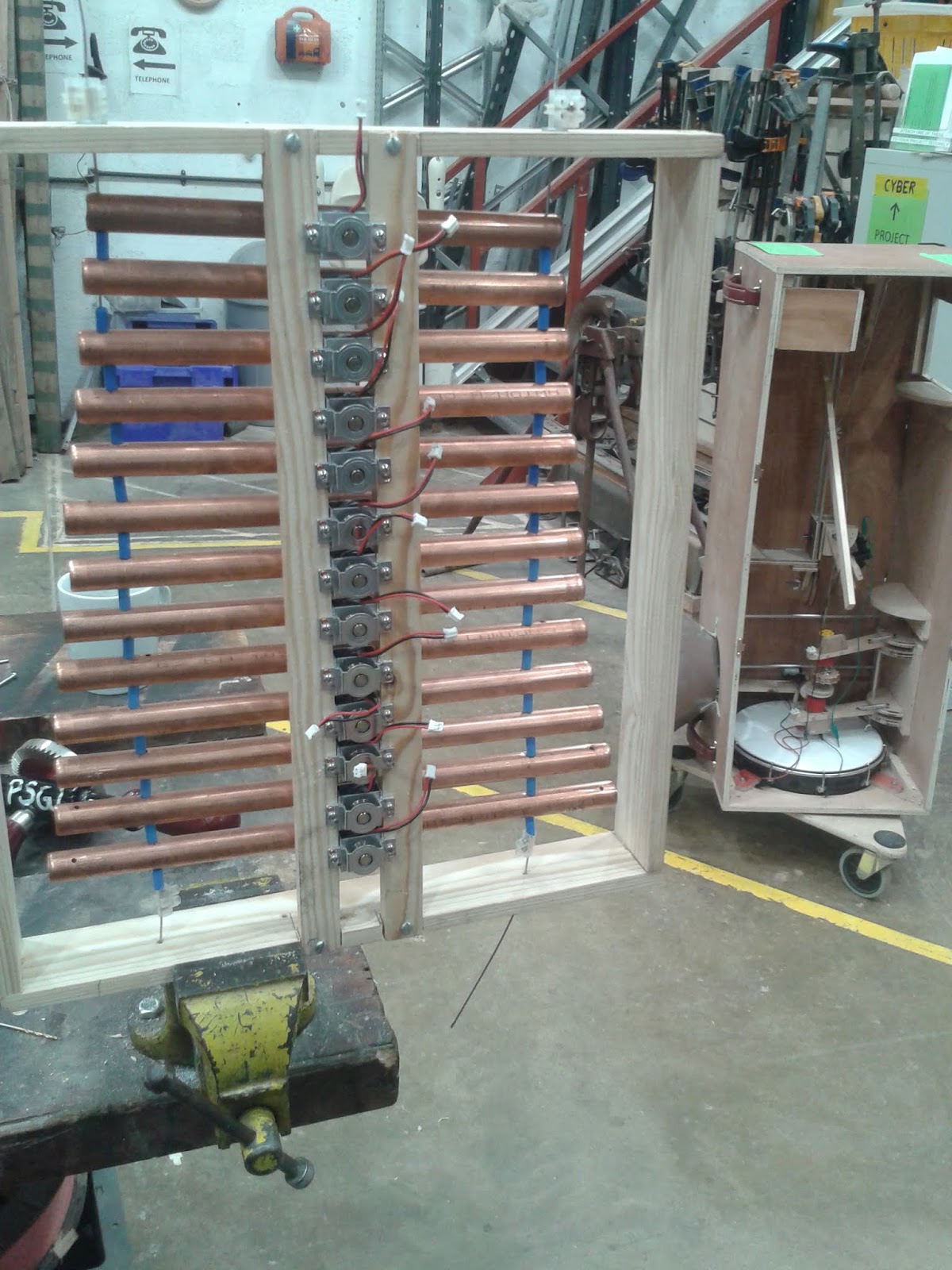
As this will be the last intonarumori I will probably make, I'm trying to get a multitude of effects and sounds within the frame work of the basic Russolo design. Doing so will make the instrument more interesting to perform, as there are only so many hours of droning you can bear to play. Today I fitted a glockenspiel which is activated by the same arm which slides the bridge. It produces a great glissando. It will also be played using a keyboard and solenoids. Should I have time I'll also look  to connecting it to an Arduino, but that is very much in the future.

glockenspiel with solenoids


Glockenspiel fitted

On the subject of glockenspiels, I recently visited the Whitechapel art gallery in London, to see 'Sense Sound/Sound Sense Fluxus Music, Scores & Records in the Luigi Bonotto Collection'

This is a great exhibition about various sound art practitioners in the 60's. I was interested to learn about the work of Joe Jones who too seems to have used small electric motors to effect sounds on a variety instruments including guitars, drums and glockenspiels. I'm going to explore his work further. Listening to a recording of Joe's work, the performance of my mechanical glockenspiel at the UFO pavilion sounds very similar. Groan the impossibility of being original.

Right side levers which pull motor driven discs into play on the string


Sunday, 21 July 2019

UFO Performance

I was invited by my friend Richard Powell to perform at the the UFO pavilion in Northampton. I suspect Richard was hoping I would bring along my intonarumoris,  but I saw this as an opportunity to trial my Bombe. Unfortunately I was making the machine 'performance ready' the morning of the day. Which meant I had no time to practice and to appreciate how it was going to play and sound.

As much as I would have liked the UFO (Racecourse) pavilion to be a homage to the heavy metal band of my youth or SciFi conotations, it stands for the more worthwhile Umbrella Fair Organisation. The event was part of Graham Fudger's 'Illuminating Art' project.


This shows the unfinished keyboard and cam note sequencer. To be quite honest the performance was not good. I thought I could 'wing' it but without a proper sound check and practice it felt too harsh and disjointed. Still I learnt a lot and people made a number of helpful suggestions at the end which I will act on. Here's the recording. Note I apologize half way through at some of the harsh notes.


Monday, 1 July 2019

The Bletchley Park Bombe near completion.

Things are starting to come together. I've completed the main body of 'The Bombe' and made a submission to the MK Gallery open for next year.
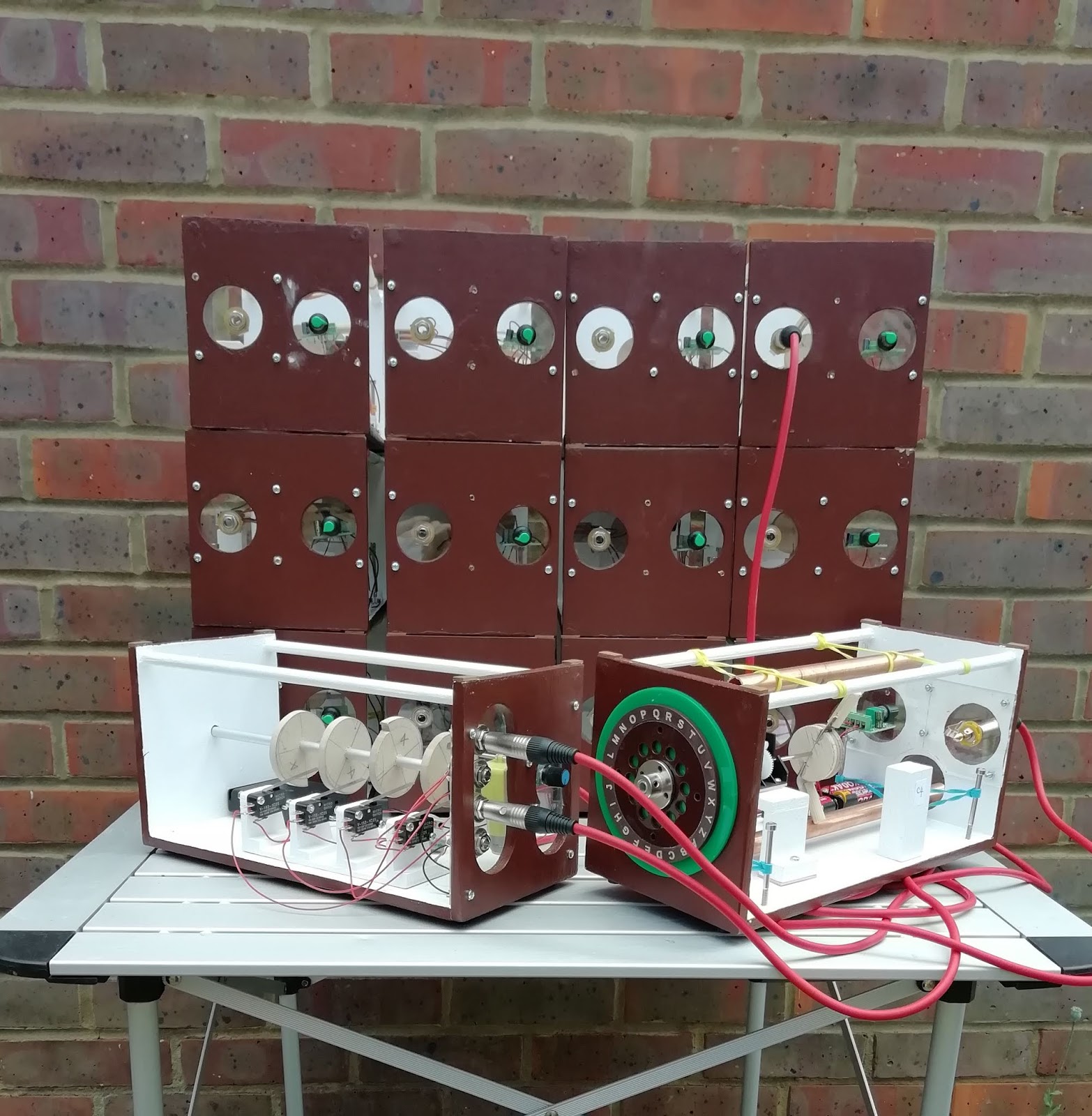
Bombe Front
Bombe back, showing cam sequencer unit.

I've still to explore the machine properly. Here's a short video of it playing.
I quite like the gentle sound it produces and the added bird song.

Here are my machines to date.The classic four piece rock band or quartet set up.
I've been invited to play at the Umbrella fair in Northampton 20th July, The UFO Pavilion.

Wednesday, 10 April 2019

Scoppiatori Burster Exploder progress

I've started work on the Scoppiatori. To be honest I don't know if these upright Intonarumori were listed as the Scoppiatori/ Burster/ Exploder but mine will make the noises Russolo described these machines as making. I have a plan and intend to use a number of string/ drum hitting mechanism to affect a variety of sounds. However these will change during the construction process, as new possibilities are suggested and my understanding of these machines is furthered.

In response to historical press reports of brass plates and bellows being inside an intonarumori, I'm going to include the plates of a xylophone (technically a glockenspiel) and possibly bellows. The xylophone can of course be used to create the 'noises like the bursting of objects that break and shatter', which Russolo mentions but, I'm also looking to get the xylophone played conventionally within the intonarumori. This is because Russolo in his book, the Art of Noises, talked about a xylophone being added to his orchestra of Intonarumoris because of it's clear dry timbres...' making an interesting contrast to the complex timbres of the noise instruments'. 

Here I've started to add three 'swinging arms', which through activating the levers will bring the motors and their effects into play against the string and drum.