Or what's in the box?
David Lien has posted his video about my Intonarumori project on his YouTube channel.
Or what's in the box?
David Lien has posted his video about my Intonarumori project on his YouTube channel.
I've spent too long on this machine and need to call it finished for now so I can move on to other projects. It is now a mechanical drum, rather than the multi faceted sound making machine it was.
There are two drum sticks activated by sudden drop snail cams and two spinning striking mechanisms.
I will probably return to this machine when it is next called on to perform. I have a number of options. There is a useful space below the drum which is directing the sound through the horn. The 45 ' of this direction reminds me of a spinning Leslie speaker which could be added here or the return of the ' Sonic Hamster wheel'.
I'm also leaving the option for two levers on the right of the machine to lower effects into play with the various mechanisms. Two levers can be seen on a machine in the photograph of Russolo with Piatti.
The Art of Noises. A talk and performance
Leighton Buzzard has/had a 'Pop up' Arts Centre in the old Wilkos store on the High Street. This is a fantastic space and resource for the town. The organisation is Culture Co:LB
This you tube video shows the space and explains it's aims.
https://youtu.be/7J9YP-gvEcU?si=YnLx6OAtdp6jad2b
and Culture Co:LB's website is here.
The group is looking for proposals for events so I submitted a talk and demonstration of my machines. Something I've been meaning to do for a long time.
The talk and demonstration was well received and the Art centre described it as a great event, with over 30 people attending. However I didn’t think it went well. I found it very stressful. My laptop wouldn't connect to the projector to show my power point presentation, so I had to convert it to a PDF and up load it to a shared drive to be linked and downloaded on another laptop, which sounds easy now I'm explaining it but I up loaded an unfinished earlier version. Doing all this meant I couldn't properly sound test my machines so the performance aspect was poor. It was like being back in the classroom with the everything going wrong and out of control. Oh and a school inspector is about to enter!
Needless to say I did not get to properly record the event. Here's a clip of the confusion, thankfully John Garrad artist and musician was on hand to drive the performance along.
As I've mentioned before my building these machines is in part a practical investigation to discover how they might have sounded and played in a modern context. I've decided my build of the the Scoppiatori Exploder/ Burster is wrong.
![]() |
I started from the premise that it was similar to the standard intonarumori with a drum and string but stood on its end. But I don't think there is any reason for this. I now think it is a mechanical drum probably based on designs by Leonardo da Vinci which Russolo would have been aware. Page 984r Codex Atlanticus. Which is held in the Biblioteca Ambrosiana in MIlan.
![]() |
| Mechanical kettle drum. Page 984r Codex Atlanticus, Picture from Wikimedia commons. |
I also don't like the sounds the machine makes. I feel they don't compliment or are that different from my other three intonarumoris. It is also far too complicated a design.
Here's the machine about to be dismantled, showing the glockenspiel, 'sonic hamster wheel' and other mechanism. I'll be looking to reuse some of these mechanisms or even make them into stand alone machines. I'm going to raise the drum and create a platform for my motor driven beaters to hit the drum. Using speed controllers this will allow for different rhythms to be set.I've inserted a board at an angle to re-direct the sound to the horn opening. I saw this on the machines designed by Luciano Chessa at the Wigmore hall concert. I will be keeping the levers to tighten the tone on the drum using either the design from Russolo's musikinstrument patent or a string as in the Ronzatori. The other levers can lower objects on to the drum to either 'dance' or to be hit by the motor beaters. Which will hopefully create the sounds Russolo describes in his book, The Art of Noises, '....like the bursting of objects that break and shatter' or 'make a noise similar to that of a gasoline engine..' But I will see how my practical experimentation will go.
David Lien Musician, Educator, and Filmmaker paid me a visit to see my intonarumori. He wanted to film my machines and interview me for an episode on his Youtube channel 'The instrument makers'.
I hired out a local church hall for an afternoon where my machines could be set out, amplified and played. It was the first time four of my machines had been brought together and played. Needless to say this process still needs to be given a little more thought.
It was a very enjoyable afternoon, David made a number of useful suggestions and his interest has inspired me to further develop the project. The visit ended with us playing a short improvised performance you can hear below.
The Orchestra of Futurist Noise Intoners. Wigmore Hall London. 17th January 2025
Conducted by Luciano Chessa
As you can see from my photograph an array of Intonarumori were there to perform, which meant you could hear a depth of tones and a range of textures. Luciano even performed a solo.
Luciano's book has been a very important reference for me in my project so it was a real privilege to see this performance. I must now finish my instruments and look to a performance.
Here's The Guardian newspaper's review of the concert.
Motorik or What!
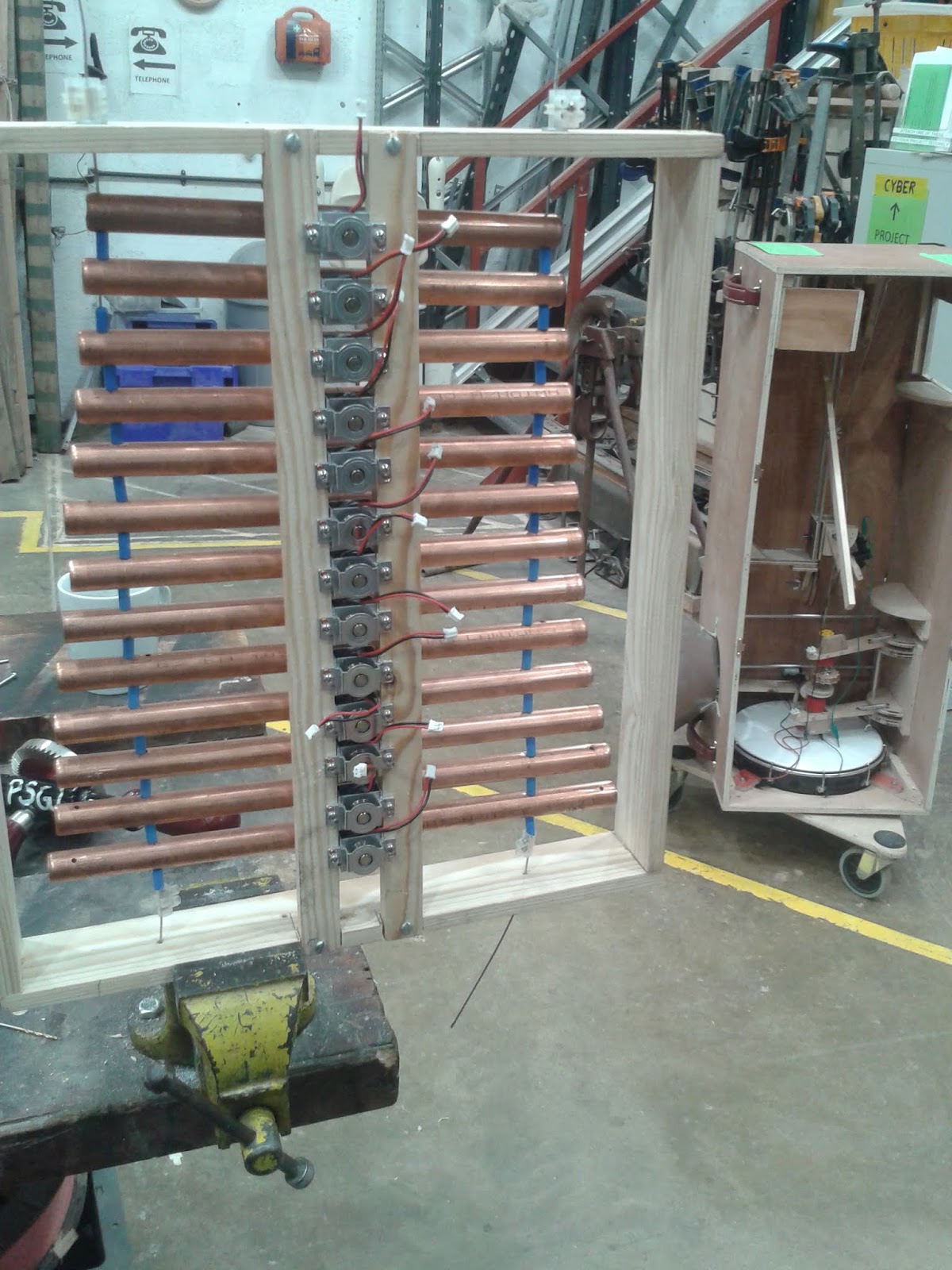
The Musikinstrument is nearly finished. I just need to tidy some aspects up. The individual tubes need separate microphones to amplify the sound in the tubes which other wise cannot be heard. This in turn needs to be to be put through a pre-amp and a mixer in order for the instrument to be played. I also need to learn how to play it!
Very Motorik as some one has said.
Russolo in his patent suggests that, 'Instead of pipes, resonators of another kind,
e.g. strings, can be used.' Here I think I'm going to try a metal spring which was used in another of Russolo's machines.
One aspect of my work is a practical investigation into these sound machines. I feel I have tried to make the scissor mechanism work by adding a support and sliding rails but this does not improve the operation, so I will take up Russolo's suggestion in his patent that this Nurnberg (Nuremberg) scissor type mechanism 'can be replaced by any other type of construction'. I'm going to use simple levers and pulleys, mechanisms Russolo has used in his other machines.
Supporting rails and linear bearings.Addition of the pulleys. Still thinking about keeping the scissor mechanism in place.
Pulleys and lever controls. This mechanism works, the only problem I have at the moment is the string 'riding off ' the pulleys. My next step is to amplify the sound in the tubes and then tidy the machine up.
People who looked at the patent plans said it wouldn't work. I wasn't too sure but by making the machine as faithfully to the plans I hoped to find out what any problems might be. Here's the final assembly.
Mechanically there is too much movement, twisting and pivoting on the lever mechanism to pull the tubes up. Either some structural supports need to be added or a completely new slider mechanism devised. Russolo in his patent says that this Nurnberg (Nuremberg) scissor type mechanism 'can be replaced by any other type of construction'.
The extension of the tubes would seem to make no difference to the sound. There is a pitch difference but that is made by the underneath pressure roller tightening the drum skin. The sound is similar to that made by my Ronzatori where the drum skin is tightened by the string. In fact Russolo suggests that the pipes could be replaced by 'resonators of another kind, e.g. Strings could be used'.
So as I blogged earlier I suspect that like the Instrument de Musique this machine was never made and really only the sketch of an idea to be developed. Ultimately the sounds it makes are a little underwhelming given the effort made to realize the machine.
Using a 3d printer I've started to print out the brackets and flanges for the telescopic tubes. Now I'm quite confident at coding and using the printer I might look to add printed parts to my earlier machines.
The Musikinstrument was another enigmatic design by Russolo. It's unclear how the instrument will be played to make the sound, but I've started to construct it and perhaps this will become clearer once it's made. Russolo obtained a patent for this machine in Germany 1920. I've put a copy here Musikinsrument patent 1920
Like the French patent of 1931, the musical instrument which used a conveyor belt to activate a spring, I wonder if it was ever made or if it will be practical. I intend to find out.
I can't decide whether to put the tubes in a linear or triangular configuration. I'll just have to see which method will achieve the best lever slide action. As you can see I'm using transparent tubes. Here I intend to have coloured lights in the machine to create a synesthesia effect which of course was one of Russolos investigations.
I've only just 'sat' the tubes on the holes. I need to 3D print some brackets once I've figured out the code. In the meantime I'll start the scissor leaver mechanism.
21st Sept progress
Underneath the drum there is a skin tensioning slider mechanism. Without a proper orthographic view of this, the drawing would suggest it slides at an angle. I think so positioned it would be difficult to work with the lever.
So I'm fixing the rail centrally.
Fixing the slider mechanism.
Russolo describes his Scoppiatori Exploder/ Burster as producing 'noises like the bursting of objects that break and shatter', I've had a bit of difficulty trying to recreate this effect. At first I was thinking along the lines of a lever using strings to lift up on a number of metal plates similar to a Venetian blind, to then drop and crash down on to a suitable resonating material. But my experiments produced a very unsatisfactory sound. So I'm now planning to using a rotating drum which will lift up a variety of material such as metal, ball bearings in the manner of a cement mixer to let it crash down. Of course the use of cement mixers and revolving drums in sound art is well established. I attended the re-enactment of the Concerto for voice and machinery at the ICA in 2007. Here the performers used two cement mixers into which were smashed bottles. You can see excerpts from this here......
Please google 'Concerto for voice and machinery ICA' for links to videos and further information about this event and the original performance in 1984. In the original performance power tools were used to destroy the stage. The performers included Genesis P-Orridge and members of Einstürzende Neubauten. By comparison my hamster style wheel will be very tame.
A metal wrap to reproduce an industrial sound. The mesh is to let the sound out. Things are starting to get a little tight fitting things inside the intonarumori. Here's a brief test using some ball bearings, nuts and bolts. The design of the wheel will allow these contents to be changed. Here's the wheel fitted inside the intonarumori.![]() | ||
| glockenspiel with solenoids |
![]() |
| Glockenspiel fitted |
| Right side levers which pull motor driven discs into play on the string |