Wednesday, 1 November 2017

Instrument de Musique

There would seem to be two patents Russolo took out which are accessible on the web. The instrument de Musique looks to be very straight forward to make from the text and plans.
 
Here's the first stage of the instrument I have built. The sound holes on the resonant box are my embellishment.


In the patent Russolo talks about the purpose of the invention.
'... is to create a musical instrument allowing the use of those longitudinal vibrations that are produced by the length ways application of a surface to a musical string. Notably, each musical string is made of a metallic thread wound into a spiral and tightened between two specific points above an appropriate resonant box. The aforementioned string is able to be struck, either by hand or stroked mechanically and tangentially by means of a loop and as seen in the diagram of the loop'.
So the next stage for me will be to build the conveyor belt. I do wonder if this instrument was ever built as the spring can't be tensioned as Russolo describes and I'm not sure if the suggested conveyor belt mechanism will create any desired sounds but I will try. At this stage I'm also unsure of what material to use for the belt. I'm quite intrigue by the Russolo's description of the instrument 'being softly and continually struck: for example, with a hand gloved in cellophane'. This may be a clue.

Working on the conveyor belt mechanism
Using a stepper motor drive belt. The ribs make an interesting sound

 The conveyor belt is an interesting mechanism. Again I wonder if it was used in any of the big floor standing intonarumori where the lever is pushed down?

Hmmm...... having motorized the belt I now wonder if the sounds it produces were worth the effort, making me further question whether the instrument was ever made.


As you can hear the electric motor drowns out any sound the spring might make. Putting a contact piezo on the spring might help here. Getting the conveyor belt to run properly was a test of my mechanical design capabilities. Here's a photo of the belt tensioning pulley I had to add.

Mind you it's pretty industrial looking and sounding. I'm going to try a different spring and conveyor belt material.

Sunday, 23 July 2017

Intonarumori 2

It's now my intention to build four intonarumoris to create a sort of 'classical quartet' or the classic four piece rock band line up. Where intonarumoris have been reproduced recently they have always been used in a controlled classical stage or museum setting. I think it would be interesting to take them out of this context and put them in the hands of contemporary musicians and non-musicians.
Having learned a lot from my experience of building an intonarumori, my making skills are finely tuned. I've now built a smaller (lead higher pitched) intonarumori. Here I have tried to follow Russolo patent drawing for the  Intonatore dei rumori. I looked to reproduce the exact proportions in my measurements. The main difference between this intonarumori and my first construction (Apart from the size) is the slider running along two rails higher in the middle of the intonarumori.

n
 You can see the rail here.
 The only change I made from the plan was not to run the string around a higher dowel labelled 'F' on Russolo's drawing, as I felt this would have over tighten the string and damaged the membrane when the lever is pulled back.

You can see the empty hole where there should be a dowel.
You'll note that the wheel I'm using here is a lot smaller. In Luciano Chessa's book he shows on page 179 which is opposite the above patent drawing, another Russolo's patent drawing for the Descrizione della prima aggiunta al brevetto depositato l'8/10/1921. This intonarumori is similar in design but has a telescopic sound box but, shows the small wheel which I have chosen to use. I'm still not happy with the sound and intend to experiment with different strings, sizes of wheel and finishes to the wheel.
I need to mention Luciano Chessa's book. Luigi Russolo, Futurist. Noise, visual arts, and the occult. This is a truly remarkable book. It hadn't been published at the start of my intonarumori construction journey but is proving to be a fantastic resource. I'll talk about this book later at greater length.

Intonarumori tweaks and a performance


Here's a shot of me playing at Milton Keynes Galleries Improvised music scratch nights on the 23rd of February. Also in the frame is John Saunders on electronics and Richard Powell on Sax. I had damaged the membrane earlier in the day fixing a new string in so the intonarumori's sound was rather harsh. After two hours of performance the membrane gave way and the handle fell off again!!

 I'm now looking at how I can make the intonarumori more robust and improve it's sound. I noticed I had the string too high up and at an angle to the turning rod. As a result the wheel wasn't touching obliquely. This could make a difference. In Russolo's patent drawing he shows the string being parallel to the wheel turning rod.

The sliding bridge will have to be much lower. I may also have to lower the lever axle. Finally I've bought a length of 12mm aluminum rod and bar for the axle and handle to try and solve the disassembly problem.


 I've also added some speaker cabinet corners and straps.

Sunday, 20 November 2016

Return to the Intonarumori, five years later!

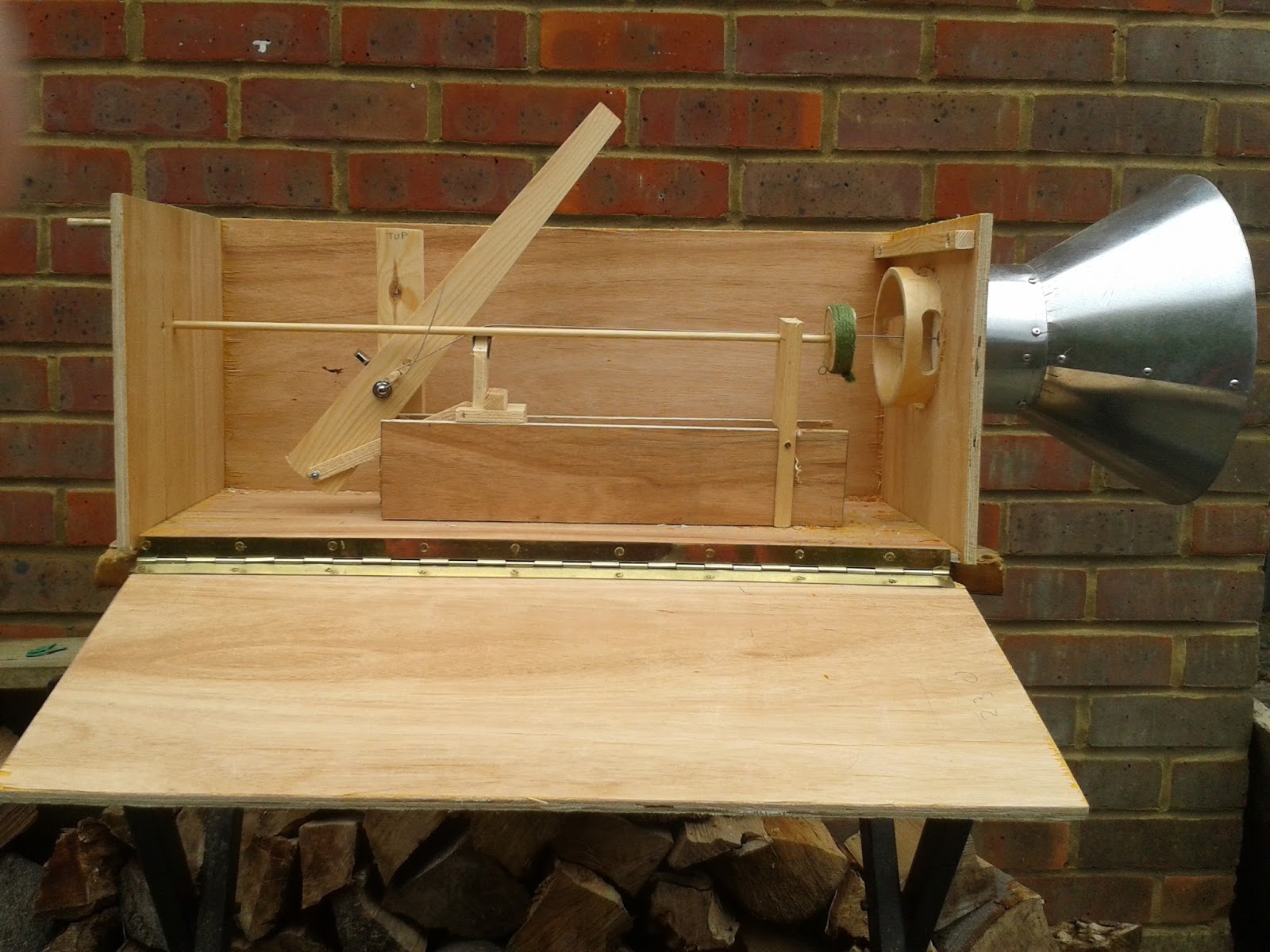
Having retired from teaching I've now got time to return to my intonarumori to finish it properly and give a performance. I was unhappy with the black plastic bucket. It didn't look right and would lead people to describe it as 'That thing with the bucket on'. Beside a metal horn would resonate better. For this I bought two sheets of galvanized steel 0.5mm thick from a local building supplies firm. This could be cut using tin snips.
I had to improvise a compass to mark out a half circle for the cone and remember Pythagoras.
Some serious use of a pop rivet gun now had to take place.

This is looks better. The riveting was very difficult. I may look to redoing it.
Oh and here's me giving the intonarumoris first performance at an Improvised experimental music workshop in Northampton. The venue was very dark and the visual recordings  made were not good so I will look to a future performance to post. However here's a sound recording which features Richard Powell on sax. John Luccibello, keyboard. Anthony Sauchella  gongs –his descriptor for himself is sacred sound improvisation artist. Lee Boyd Allatson –drums. Many thanks to these guys for letting me join in. The intonarumori is making a sort of ump pah drone sound in the background.


Wednesday, 11 April 2012

Intonarumori nearly finished

Here's my finished Intonarumori. OK I've still got to varnish and tidy it up.


 Here's a close up of a small brass pulley wheel I put on the sliding mechanism. this improved the performance.
 I also put a smaller pulley on the lever arm this again improved its working by not tightening the string when it was drawn back. This was happening before and making the sliding bridge not move smoothly.
 Finally I added and alternative spinning disc which plucks the string.
Here's it in action,
I'd still like to improve the tone it doesn't have the nice rasp that Jonnda's has. I will try his recommendation of using cello resin on my smooth disc.

I now hope my sons will try it out at one of their Circuit Breaker gigs. https://circuitbreakerband.com/

Well it took me nearly 6 years to finish this project. I must now turn my attention to the Laurie Anderson Violin I was making.

Tuesday, 10 April 2012

Return to the Intonarumori Tuesday 10th April 2012

Gosh it's been over 8 months since I've worked on this. I'm now determined to get it finished, but a few problems remain. Using a guitar machine head to tension the string seems to work well however a guitar bridge on the bridge does not. There is too much friction here when the bridge slides. I'm going to craft a small metal pulley instead which will turn. I'm also not sure about the tone a metal gauge 42 guitar string gives and the wood rubbing against this string. I will have to experiment here.
It may sound better when enclosed.
Here's a shot of the guitar machine head.
And here's the problematic guitar bridge on the slider.